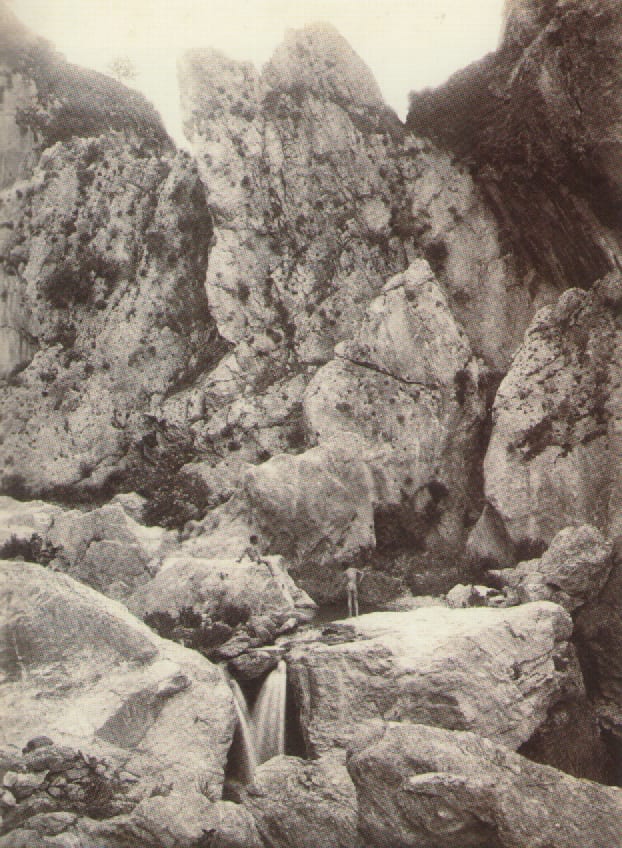
The Gorges as a geological laboratory
The Alcantara Gorges are not just a landscape: they are one of the few places in Italy where a visitor can read with the naked eye the story of a volcano and a river in dialogue. Every wall of the canyon is an open book of volcanology: the organ-pipe shapes of the columnar basalt tell of rapid cooling of a lava flow; the rosettes show concentric contraction nuclei; the fans reveal parallel fractures along flow directions. The river, running through it, has carved the bed we see today over the last few millennia.
How the columnar walls form
When a basaltic lava flow cools slowly at the surface, it tends to create a solid crust over a still-fluid mass. When it cools rapidly, for example because it meets running water or groundwater, thermal contraction generates regular fractures that organise the rock into polygonal-section columns.
The most common sections are:
- Hexagonal, the geometry that minimises contraction energy and therefore the most common;
- Pentagonal, frequent where cooling is slightly less homogeneous;
- Quadrangular or irregular, where there are local asymmetries in the lava mass.
In the Alcantara Gorges these sections appear in vertical, horizontal and curved orientations, because the original lava flows followed different courses before solidifying.
Age of the lava flows
The rocks visible in the gorges belong to different phases of Etna’s eruptions. The most solid geological reconstructions indicate:
- Older lava flows datable to over 300,000 years ago, part of the long cycle of construction of the Etna edifice;
- Younger flows linked to Holocene-age eruptive activity;
- For the area of the Vulcanetto di Mojo, eccentric pyroclastic eruptions about 8,000 years ago deposited the cone we visit today.
River erosion did not simply “cut” the lava: it acted on comparable geological timescales, progressively excavating the canyon.
Hypotheses on the canyon’s formation
Two main hypotheses, not necessarily mutually exclusive, exist for the geometric origin of the canyon.
Morphological hypothesis
The river progressively eroded the lava mass at points of lower resistance, exploiting cooling fractures and discontinuities. Over long timescales, the action of water and transported material widened and deepened the bed, creating the present canyon.
Tectonic hypothesis
The initial canyon may have been a fault opened by a seismic event, in which the river later channelled itself. Fluvial erosion then shaped the fracture into a true canyon.
In both cases, the final product is a valley narrow in places to 2-5 metres and as tall as 25-30 metres: a height-to-width ratio that very few canyons in the world reach.
The geosites of the valley
The Gorges are not the only point of geological interest. A more in-depth visit can include:
Vulcanetto di Mojo
An eccentric pyroclastic cone of Etna (formed outside the main crater), about 50 metres tall, dated around 8,000 years ago. It is one of the few eccentric cones you can walk on with a crater loop. The Mojo trail climbs to the rim.
Little Gorges
A stretch of the river where the basalt walls narrow into a miniature canyon. Accessible from the Ponte di San Nicola of Castiglione di Sicilia. Geologically it is the same phenomenon as the Larderia Gorges, but on a smaller scale.
Gurne dell’Alcantara
Erosion basins (potholes) carved by the river into basalt. They form when a vortex traps stones and sand which, rotating, abrade the rock to create a circular pool. The Gurne di Francavilla are the best-known example.
Grotta dei Cento Cavalli
A large lava tube, formed when a flow solidified at the surface while the interior continued to flow, leaving a tunnel. One of the largest lava tubes in Italy.
Byzantine cubes
The cubes, small cube-plan churches, are not geological in themselves, but are built in local lava stone and tell how humans reused volcanic rock. The Cuba di Santa Domenica in Castiglione di Sicilia is one of the purest examples.
What to look for with your eyes
When you walk inside the gorges, try to observe:
- Direction of the columns: where they are vertical, lava cooled in a horizontal pose; where they are horizontal, lava cooled in a flow that changed gradient.
- Fan structures: indicate a flow that hit an obstacle and “opened” radially.
- Concentric rosettes: points where a localised cooling nucleus generated circular series of fractures.
- Colour changes: alterations of the stone due to mineral infiltration or oxidation.
- Pools and potholes: points where concentrated erosion has carved basins, similar in miniature to the Gurne.
Further reading
- Vulcanetto di Mojo itinerary, to see an eccentric pyroclastic cone.
- Alcantara Gorges guide, the main page on the visit.
- Little Gorges itinerary, the “pocket” version of the same phenomenon.