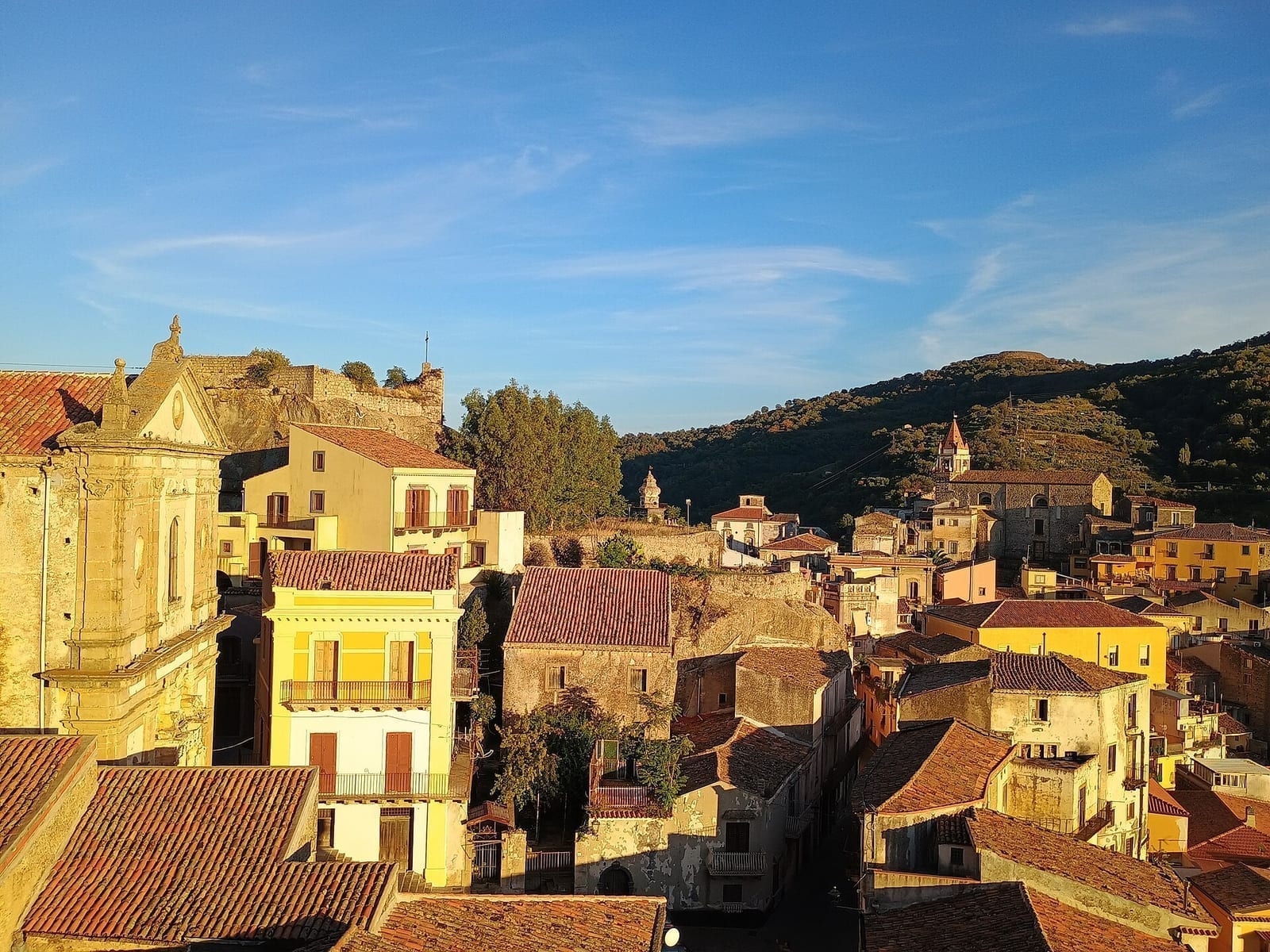
A village built on a lava flow
Castiglione di Sicilia is not simply a village “above” the Alcantara Valley: it is set into it, built on a lava-rock spur that juts out over the river. Its black stone houses, narrow paved streets, and stairways climbing to the castle, every element is part of a stratification spanning at least three thousand years that today makes Castiglione one of the most distinctive villages in eastern Sicily.
The historical nickname Castel Leone says it all: under Frederick II it became a royal city with the privilege of minting coinage, a rare recognition that signals its strategic importance. It stood at the centre of a network of castles overseeing the Alcantara Valley, but it was here, in the commanding position over the river and the Etna slope, that the territory’s military and fiscal power was concentrated.
What to see
Castel Leone
The remains of the castle, in a commanding position on the upper part of the village, offer the most complete panorama of the Alcantara Valley: Mount Etna to the south, the Peloritani to the north, the river valley to the east. For visitors to Castiglione it is a mandatory stop, even just for the photograph.
Byzantine Cuba di Santa Domenica
A short way from the centre, the Cuba di Santa Domenica is a small cube-plan church from the 7th-8th century. It is one of the few surviving examples of rural Byzantine architecture in Sicily. The essential style, square base, internal dome, lava-stone construction, recounts a lesser-known but important phase of Sicilian history, that of the Basilian communities.
Historic centre
The streets of the centre are narrow, paved, lined with lava-stone houses. Walk them on foot, slowly, with stops at the small panoramic points. The best light is at sunset, when the lava stones take on warm reflections.
Ponte di San Nicola and Little Gorges
In the lower part of the municipal territory, the Ponte di San Nicola is an ancient lava-stone bridge from which the trail to the Little Gorges starts. It is a natural extension of the village visit for those wanting to combine culture and river.
Etna DOC wines
Castiglione is one of the reference points for the Etna DOC appellation. Its volcanic soils host the native varieties:
- Nerello Mascalese and Nerello Cappuccio for reds;
- Carricante and Catarratto for whites.
Local wineries, many integrated into the vineyard landscape, some with hospitality and dining facilities, offer tours, tastings and food pairings. For travellers in the Alcantara Valley, a winery stop is the most direct way to understand why the northern slope of Mount Etna is considered one of the most interesting terroirs in Italy.
How to get there
- From Taormina/Giardini-Naxos: ~30 km, 35 minutes on the SS 185 inland.
- From Catania: ~70 km, 80 minutes via A18 + SS 185.
- By train: the Circumetnea railway stops at Randazzo (~10 km from Castiglione). From Randazzo, taxi or rental car.
- By car from Catania-Fontanarossa: ~75 km, 80-90 minutes.
When to go
- Spring (April-June): ideal weather, vineyards in vegetative phase, sharp panoramas.
- September-October: harvest of the Etna grapes, the most evocative time to visit the wineries.
- Summer: pleasant evenings, ideally combined with an evening visit to the village.
- Winter: with snow on Mount Etna, the panorama is spectacular; some services in the village are reduced.
What to combine
- Morning at the Gorges + lunch in Castiglione + afternoon at a winery.
- Little Gorges itinerary + visit to the historic centre + Cuba di Santa Domenica.
- Castle tour: Castiglione + Randazzo in one day, experienced as a cultural continuum.
Practical tips
- Park in the lower part of the village: driving up to the castle is awkward, the centre’s streets are narrow.
- Comfortable shoes: the paving is uneven and uphill.
- Water and sun protection in summer, especially if you climb up to Castel Leone.
- Book the winery in advance: in the September-October weekends demand is high.