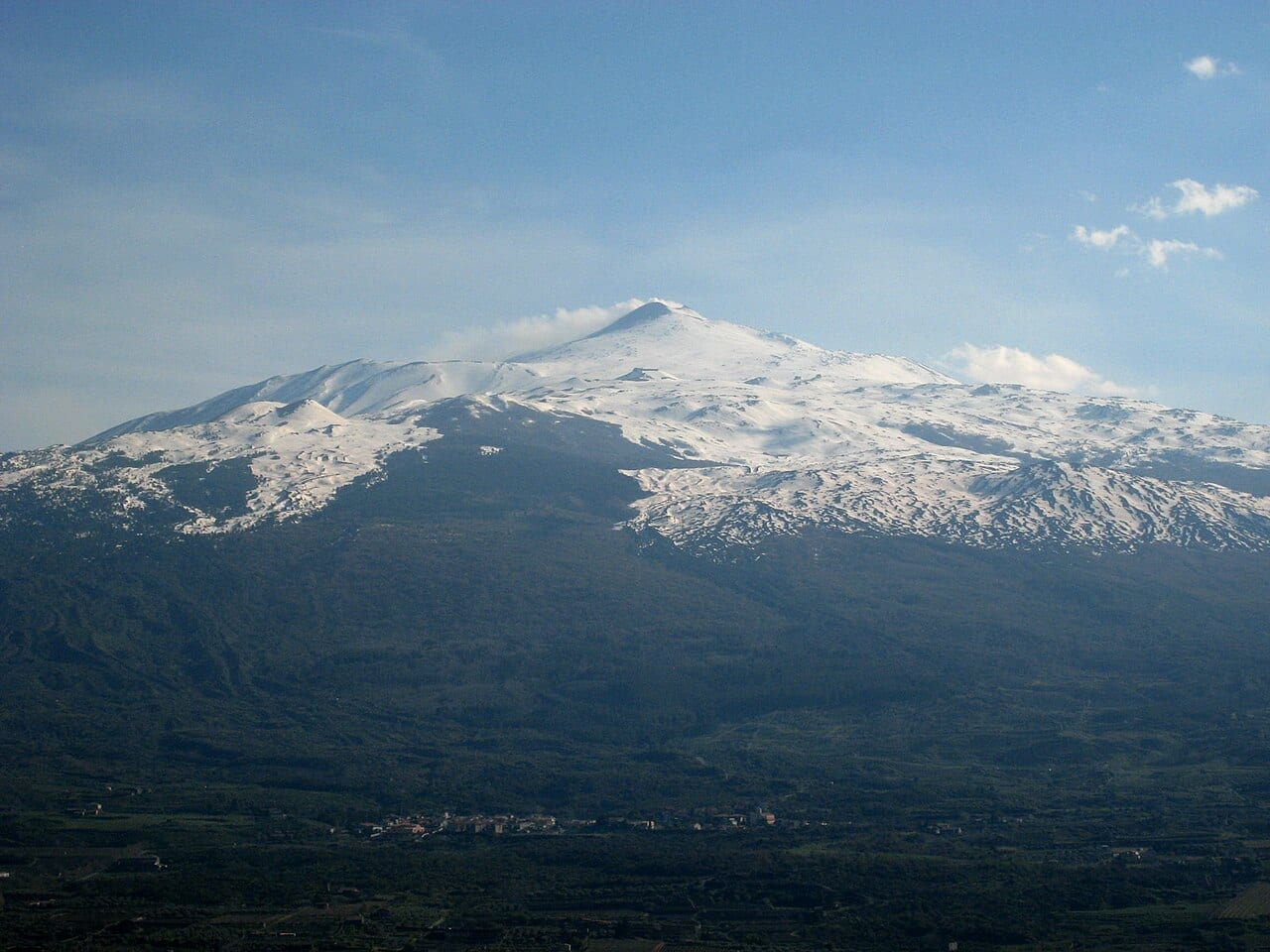
The village of the Vulcanetto
Mojo Alcantara is one of the smallest municipalities in the Alcantara Valley (around 700 inhabitants) but one of the most relevant from a geological point of view. The village sits at 460 metres of altitude on the valley floor, but what makes it immediately recognisable is the Vulcanetto di Mojo: an eccentric pyroclastic cone of Mount Etna, about 50 metres tall, that rises beside the village and becomes its strongest visual symbol.
For visitors interested in geology, Mojo is an essential stop. For long-distance hikers, it is a node on the Sentiero Italia CAI: stage V23F arrives at Mojo from northern Etna, and V23G leaves Mojo for the Peloritani.
Vulcanetto di Mojo
The Vulcanetto is an eccentric pyroclastic cone of Mount Etna, formed about 8,000 years ago by a lateral eruption of the main volcano. It is one of the few well-preserved eccentric Etna cones still walkable.
What makes it interesting
- It is a textbook case of volcanology: regular cone, visible crater, recognisable pyroclastic deposits.
- The crater rim loop offers a 360° panorama over the Alcantara Valley.
- Educational panels along the trail explain the geology accessibly.
- For visitors who do not climb Etna but still want to “touch” a volcanic feature, Mojo is the most immediate option in the valley.
The trail
The Vulcanetto itinerary starts from the village and climbs at moderate gradient to the crater rim. It is about 3.5 km in total including the rim loop. Moderate difficulty, light boots recommended. Avoid the central hours in summer.
What to see in Mojo village
The historic centre is small and has a rural identity more than a monumental one. It is a valley-floor village with typical architecture: low houses, a few minor religious buildings, a few interesting glimpses. It can be visited in 30-45 minutes.
The real reason for stopping in Mojo is the Vulcanetto and the landscape setting: Etna DOC vineyards on volcanic soils, panorama of Etna to the south, the Peloritani to the north.
How to get there
- From Taormina/Giardini-Naxos: ~35 km, ~45 minutes via SS 185 + secondary roads.
- From Catania: ~80 km, ~90 minutes via A18 + SS 120 + secondary roads.
- From Randazzo: ~10 km, 15 minutes.
- From Francavilla di Sicilia: ~12 km, 15-20 minutes.
- By bus: limited Interbus services, especially at weekends.
When to go
- Spring (April-June): ideal weather for the Vulcanetto trail.
- September-October: harvest season, an excellent pairing with Etna DOC wineries.
- Summer: avoid the central hours. Early morning or late afternoon.
- Winter: walkable in good weather; possible wind on the cone.
What to combine
- Vulcanetto di Mojo + Alcantara Gorges: two complementary geological stops.
- Mojo + Randazzo: nearby villages, combinable in half a day.
- CAI stage: for hikers, natural to break V23F (arrival) and V23G (departure) using Mojo as a base.
Practical tips
- Light boots recommended for the climb to the Vulcanetto.
- Plenty of water: no fountains on the trail.
- Mobile coverage: good in the village, can vary on the climb.
- Parking in the village or at the trailhead (signposted).
- Accommodation is limited: for stays it is best to contact local farm-stays or B&Bs in advance.