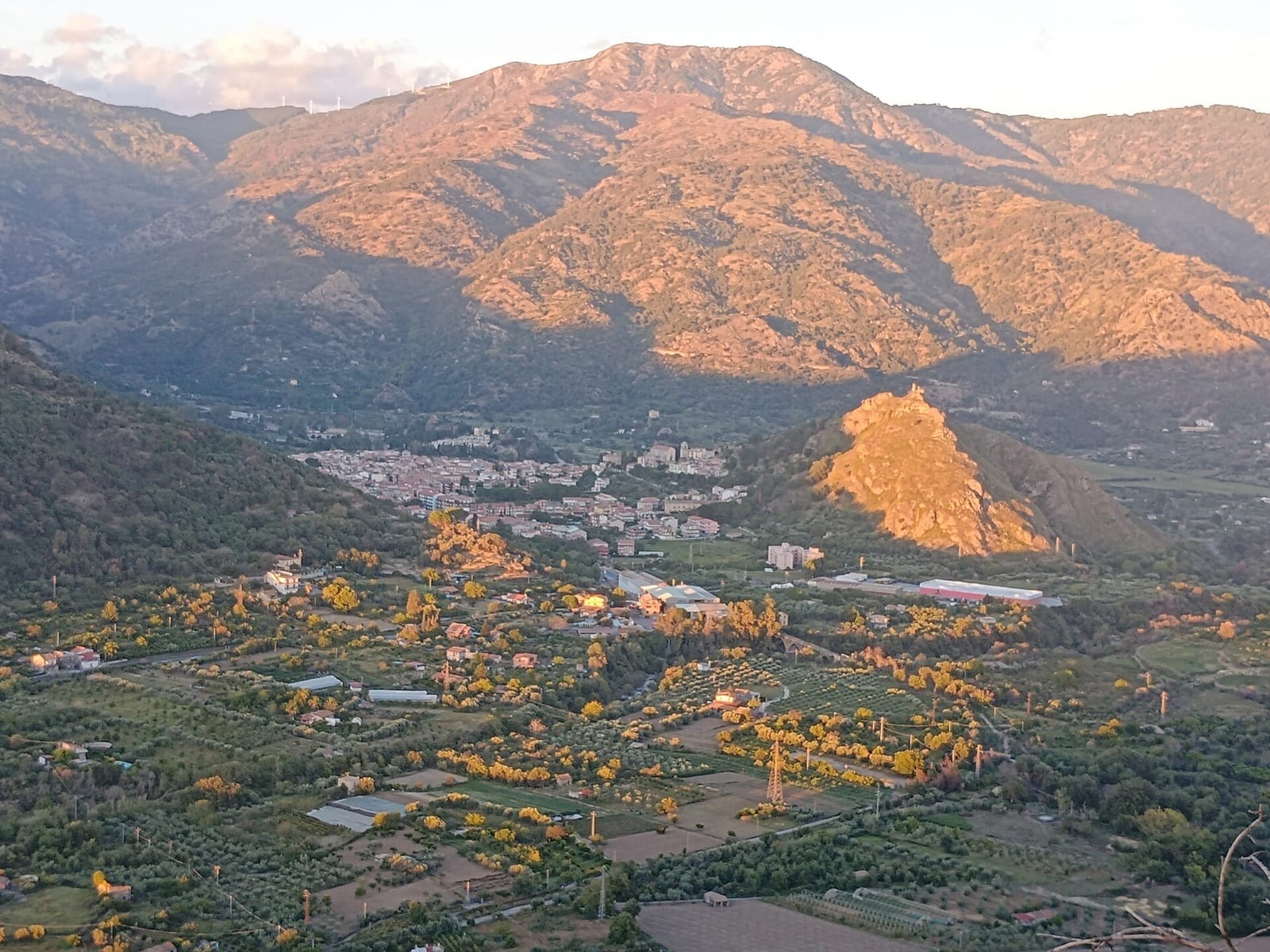
A valley shaped by castles
The Alcantara Valley is one of the few corners of Sicily where castles are not isolated monuments: they form a system. From the river mouth to the upper valley floor, every strategic node along the river and the SS 185 is overseen by a fortress, a castle or a tower. The landscape reads like a medieval military map: whoever controlled the valley controlled one of the main routes between the Ionian coast and the interior.
The castles you see today belong to different layers. Some have Byzantine foundations; others are the work of the Normans who entered Sicily in the 11th century; still others were enlarged and reworked under the Hohenstaufens and the Aragonese. Most experienced phases of splendour, abandonment and reuse, and today they stand alongside the villages they protected for centuries.
Castle of Calatabiano
Where: Calatabiano, at the mouth of the Alcantara, in a commanding position over the plain.
Why it mattered: the castle watched over the river mouth and the coastal plain up to Taormina. Its position on an isolated hill makes it still today one of the most scenic fortresses in eastern Sicily.
History: medieval origin, refounded by the Normans and consolidated under the Aragonese. It suffered damage from the earthquakes of 1693 and 1818, was long abandoned and was finally restored over the past twenty years.
What to visit:
- the perimeter walls,
- the main tower,
- the sanctuary of San Filippo Siriaco inside the complex,
- the funicular access, one of the few in Sicily.
Services: parking below, seasonal ticket office, guided tours possible.
Castel Leone (Castiglione di Sicilia)
Where: upper part of the historic centre of Castiglione di Sicilia, on a lava spur.
Why it mattered: the castle dominated the upper Alcantara basin and the northern Etna ridge. Under Frederick II, Castiglione was a royal city with the right to mint coinage, a sign of its strategic and political importance.
History: protohistoric for the natural fortress, Byzantine and then Norman for the stone structures. Frederick II turned it into a royal stronghold. In the late Middle Ages it passed through various feudal families (Lauria, among others, gives its name to part of the structure).
What to visit:
- the remains of the walled enclosure,
- the Torre di Lauria in a panoramic position,
- the panorama over the Ionian Sea, Mount Etna and the lower valley (perhaps the most complete in the valley),
- the Cuba bizantina of Santa Domenica nearby, one of the few cube-plan Byzantine churches in Sicily.
Services: free access to the trails, possible guided tours organised by the municipality.
Castle of Francavilla di Sicilia
Where: Francavilla, on a rocky spur dominating the confluence of the Zavianni torrent with the Alcantara.
Why it mattered: a stronghold for the middle valley and the passage towards the gorges. For a long time it was the strategic observation point between the coast and the slopes of Etna.
History: medieval origin, expanded by the Normans and fortified by the Aragonese. It suffered heavy damage over the centuries and survives today as a consolidated ruin.
What to visit:
- the Convento dei Cappuccini, which dominates the village and acts as a visual reference;
- the fortification remains, reachable via a panoramic climb;
- the way the castle sits within the fabric of the village, which is worth exploring on foot.
Services: free outdoor access; indoor opening hours variable.
Fortifications of Motta Camastra
Where: Motta Camastra, dominating the Alcantara Gorges.
Why it mattered: the Motta rock directly oversaw the entrance to the basalt gorges and the road through the valley. The toponym itself (motta = fortified height) declares it.
History: the village arose in the medieval period as a defensive settlement. The proper fortification was expanded under the Normans and the Hohenstaufen-Aragonese.
What to visit:
- the remains of the fortress at the top of the village;
- the panorama over the valley and the gorges;
- the historic centre in lava stone;
- the municipal staircase that leads directly into the Alcantara Gorges, at the edge of the municipal territory.
Randazzo: a fortified city
Where: Randazzo, at the northern entrance to the upper valley.
Why it mattered: Randazzo did not have a single castle: it was itself a fortified city, with an integrated system of walls and towers. For centuries it was one of the most important cities in the Etna area, the informal capital of northern Etna.
History: ancient foundation, medieval reconstruction after invasions and earthquakes. Frederick II made it a royal stop; under the Aragonese it became the seat of the itinerant court for some periods.
What to visit:
- the Porta Aragonese, historic gateway to the village;
- the Torre di Re Ruggero, an example of Norman military architecture;
- the three mother churches of the village (San Martino, Santa Maria, San Nicola), unique of their kind;
- the entire historic centre in lava stone.
Suggested itinerary (2 days)
Day 1 - Lower valley and river mouth
- Morning: Castle of Calatabiano (3-4 hours with funicular).
- Lunch: in Calatabiano or in Giardini-Naxos.
- Afternoon: transfer to Francavilla di Sicilia, visit the village and the castle remains, possible link to the Gurne trail.
Day 2 - Middle and upper valley
- Morning: Motta Camastra and the Alcantara Gorges.
- Lunch: in Castiglione di Sicilia with a view of the vineyards.
- Afternoon: visit Castel Leone and the historic centre of Castiglione, or Randazzo if you have time.
In a single day, the ideal loop is: Castiglione in the morning, Randazzo in the early afternoon. Calatabiano and Francavilla can be left for a second day or for those travelling from Taormina.
Practical tips
- To visit the interiors of the castles, call or email the municipalities in advance: opening hours change.
- All the castles offer outstanding panoramas: bring a camera with a good wide-angle lens.
- Access paths are often steep and stony: trekking shoes, no city footwear.
- Consider combining the castle visits with Etna DOC wineries: many are integrated into the historic villages.
Further reading
- Castiglione di Sicilia, village page.
- Francavilla di Sicilia, village page.
- Calatabiano, village page.
- History of the Alcantara Valley, general historical overview.